Product ProductLink |
|
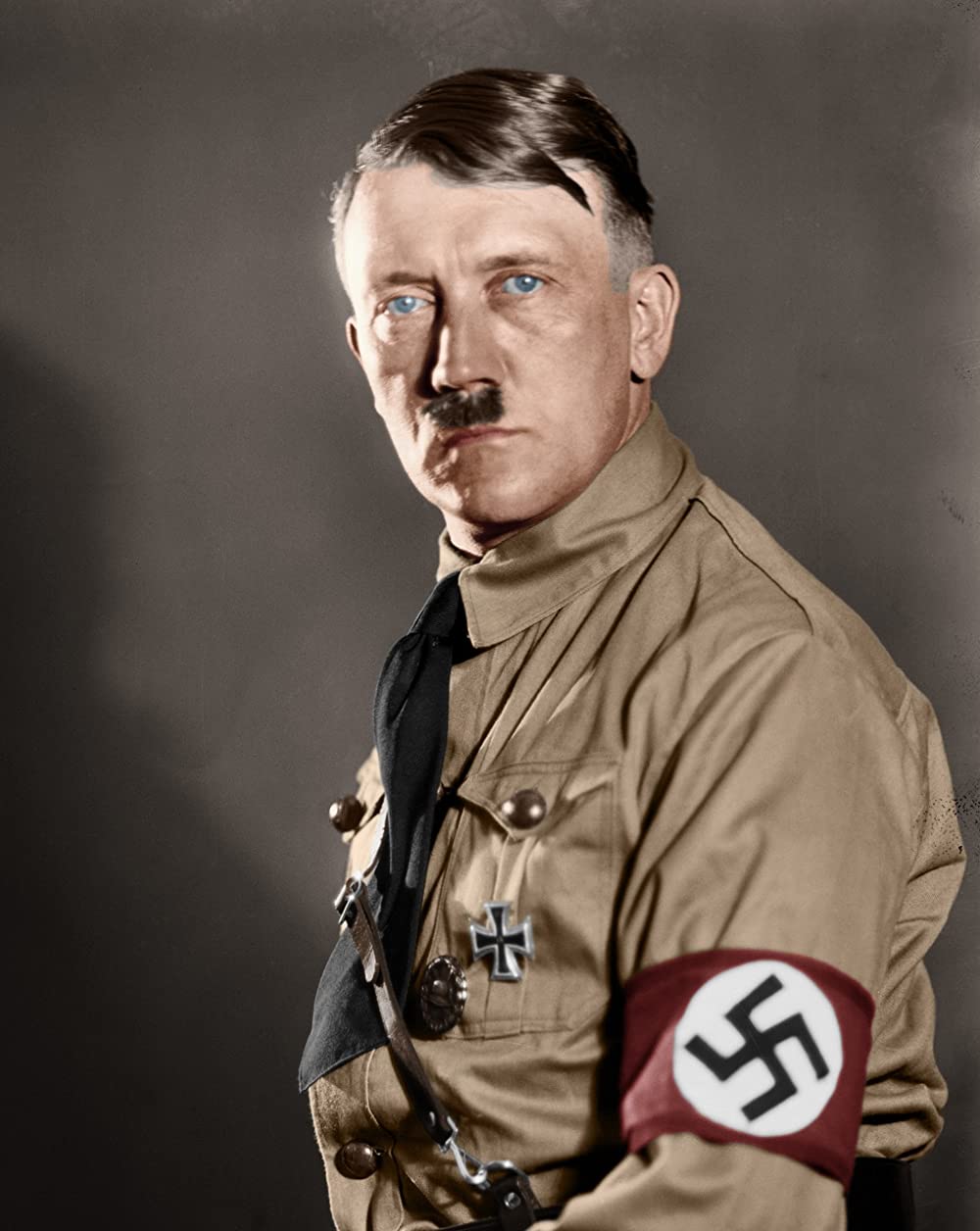
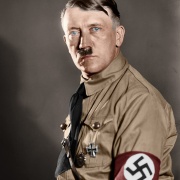 Born the fourth of six children to Austrian customs officer Alois Hitler--who had been married twice before--and the former Klara Polzl, Adolf Hitler grew up in a small Austrian town in the late 19th century. He was a slow learner and did poorly in school. He was frequently beaten by his authoritarian father. Things got worse when Adolf's older brother, Alois Jr., ran away from home. His mild-mannered mother occasionally tried to shield him, but was ineffectual. Adolf's attempt to run away at 11 was unsuccessful. At the age of 14 he was freed when his hated father died - an event that he did not mourn.Hitler dropped out of high school at age 16 and went to Vienna, where he strove to become an artist, but was refused twice by the Vienna Art Academy. By this time Hitler had become an ardent German nationalist--although he was not German but Austrian--and when World War I broke out, he crossed into Germany and joined a Bavarian regiment in the German army. He was assigned as a message runner but also saw combat. Temporarily blinded after a gas attack in Flanders in 1918, he received the Iron Cross 2nd Class and was promoted from private to corporal. In 1918, when the war ended, Hitler stayed in the army and was posted to the Intelligence division. He was assigned to spy on several radical political parties that were considered a threat to the German government. One such organization was the German Workers' Party. Hitler was drawn by party founder Dietrich Eckart, a morphine addict who propagated doctrines of mysticism and anti-Semitism. Hitler soon joined the party with the help of his military intelligence ties. He became party spokesman in 1919, renamed it the National Socalist German Workers Party (NSDAP/NAZI) and declared himself its F��hrer (leader) one year later. In 1920 Hitler's intelligence handler, Munich-based colonel named Karl Haushofer, introduced the swastika insignia. In 1921 Haushofer founded the paramilitary Storm Troopers ("Sturmabteilung", or SA), composed of German veterans of WWI and undercover military intelligence officers. They helped Hitler to organize a coup attempt--the infamous "beer hall putsch"--against the Bavarian government in Munich in 1923, but it failed. The "rebels" marched on Munich's city hall, which was cordoned off by police. Hitler's men fired at the police and missed; the police fired back and didn't, resulting in several of Hitler's fellow Nazis being shot dead. Hitler himself was arrested, convicted of treason and sent to prison. During his prison time he was coached by his advisers and dictated his book "Mein Kampf" ("My Struggle") to his deputy Rudolf Hess. He only served several months in prison before being released. By 1925 the Nazi party was in much better straits both organizationally and financially, as it had secured the backing of a large group of wealthy conservative German industrialists, who funneled huge amounts of money into the organization. Hitler was provided with a personal bodyguard unit named the "Schutzstaffel", better known as the SS. The Nazis began to gain considerable support in Germany through their network of army and WWI veterans, and Hitler ran for President in 1931. Defeated by the incumbent Paul von Hindenburg, Hitler next attempted to become Chancellor of Germany. Through under-the-table deals with powerful conservative businessmen and right-wing politicians, Hitler was appointed Chancellor in January 1933. One month later, a mysterious fire--which the Nazis claimed had been started by "terrorists" but was later discovered to have been set by the Nazis themselves--destroyed the Reichstag (the building housing the German parliament). Then Hitler's machine began to issue a series of emergency decrees that gave the office of Chancellor more and more power.In March of 1933 Hitler persuaded the German parliament to pass the Enabling Act, which made the Chancellor dictator of Germany and gave him more power than the President. Two months later Hitler began "cleaning house"; he abolished trade unions and ordered mass arrests of members of rival political groups. By the end of 1933 the Nazi Party was the only one allowed in Germany. In June of 1934 Hitler turned on his own and ordered the purge of the now radical SA--that he now saw as a potential threat to his power--which was led by one of his oldest friends, a thug and street brawler named Ernst R?hm. R?hm's ties to Hitler counted for nothing, as Hitler ordered him assassinated. Soon President Hindenburg died, and Hitler merged the office of President with the office of Chancellor. In 1935 the anti-Jewish Nuremburg laws were passed on Hitler's authorization. A year later, with Germany now under his total control, he sent troops into the Rhineland, which was a violation of the World War I Treaty of Versailles. In 1938 he forced the union of Austria with Germany and also took the Sudetenland, a region of Czechoslovakia near the German border with a large ethnic German population, on the pretext of "protecting" the German population from the Czechs. In March 1939 Hitler overran the rest of Czechoslovakia. On 23 August 1939 Hitler and Iosif Stalin made a non-aggression treaty. In September of 1939 Hitler and Stalin invaded Poland. France and the British Commonwealth and Empire declared war on Germany. In 1940 Germany occupied Denmark, Norway and the Low Countries, and launched a major offensive against France. Paris fell and France surrendered, after which Hitler considered invading the UK. However, after the German Air Force was defeated in the Battle of Britain, the invasion was canceled. The British had begun bombing German cities in May 1940, and four months later Hitler retaliated by ordering the Blitz. In 1941 German troops assisted Italy, which under dictator Benito Mussolini was a German ally, in its takeover of Yugoslavia and Greece. Meanwhile, in Germany and the occupied countries, a program of mass extermination of Jews had begun.On June 22, 1941, German forces invaded the Soviet Union. In addition to ore than 4,000,000 German troops, there were additional forces from German allies Romania, Italy, Czechoslovakia, Hungary, Croatia, Spain and Finland, among others. Hitler used multinational forces in order to save Germans for the future colonization of the Russian lands. Following the detailed Nazi plan, code-named "Barbarossa," Hitler was utilizing resources of entire Europe under Nazi control to feed the invasion of Russia. Three groups of Nazi armies invaded Russia: Army Group North besieged Leningrad for 900 days, Army Group Center reached Moscow and Army Group South occupied Ukraine, reached Caucasus and Stalingrad. After a series of initial successes, however, the German Armies were stopped at Moscow, Leningrad and Stalingrad. Leningrad was besieged by the Nazis for 900 days until the city of 4,000,000 virtually starved itself to death. Only in January of 1944 was Marshal Georgi Zhukov able to finally defeat the German forces and liberate the city, finally lifting the siege after a cost of some 2,000,000 lives. In 1943 several major battles occurred at Kursk (which became the largest tank battle in history), Kharkov and Stalingrad, all of which the Germans lost. The battle for Stalingrad was one of the largest in the history of mankind. At Stalingrad alone the Germans lost 360,000 troops, in addition to the losses suffered by Italian, Hungarian, Romanian, Czech, Croatian and other forces, but the Russians lost over one million men. By 1944--the same year the Western allies invaded occupied Europe--Germany was retreating on both fronts and its forces in Africa had been completely defeated, resulting in the deaths and/or surrender of several hundred thousand troops. Total human losses during the six years of war were estimated at 60,000,000, of which 27,000,000 were Russians, Ukrainians, Jews and other people in Soviet territory. Germany lost over 11,000,000 soldiers and civilians. Poland and Yugoslavia lost over 3,000,000 people each. Italy and France lost over 1,000,000 each. Most nations of Central and Eastern Europe suffered severe--and in some cases total--economic destruction.Hitler's ability to act as a figurehead of the Nazi machine was long gone by late 1944. Many of his closest advisers and handlers had already fled to other countries, been imprisoned and/or executed by the SS for offenses both real--several assassination attempts on Hitler--and imagined, or had otherwise absented themselves from Hitler's inner circle. For many years Hitler was kept on drugs by his medical personnel. In 1944 a group of German army officers and civilians pulled off an almost successful assassination attempt on Hitler, but he survived. Hitler, by the beginning of 1945, was a frail, shaken man who had almost totally lost touch with reality. The Russians reached Berlin in April of that year and began a punishing assault on the city. As their forces approached the bunker where Hitler and the last vestiges of his government were holed up, Hitler killed himself. Just a day earlier he had married his longtime mistress Eva Braun. Hitler's corpse was taken to Moscow and later shown to Allied Army Commanders and diplomats. Iosif Stalin showed Hitler's personal items to Winston Churchill and Harry S. Truman at the Potsdam Conference after the victory. Hitler's personal gun was donated to the museum of the West Point Military Academy in New York. Some of his personal items are now part of the permanent collection at the National History Museum in Moscow, Russia. Born the fourth of six children to Austrian customs officer Alois Hitler--who had been married twice before--and the former Klara Polzl, Adolf Hitler grew up in a small Austrian town in the late 19th century. He was a slow learner and did poorly in school. He was frequently beaten by his authoritarian father. Things got worse when Adolf's older brother, Alois Jr., ran away from home. His mild-mannered mother occasionally tried to shield him, but was ineffectual. Adolf's attempt to run away at 11 was unsuccessful. At the age of 14 he was freed when his hated father died - an event that he did not mourn.Hitler dropped out of high school at age 16 and went to Vienna, where he strove to become an artist, but was refused twice by the Vienna Art Academy. By this time Hitler had become an ardent German nationalist--although he was not German but Austrian--and when World War I broke out, he crossed into Germany and joined a Bavarian regiment in the German army. He was assigned as a message runner but also saw combat. Temporarily blinded after a gas attack in Flanders in 1918, he received the Iron Cross 2nd Class and was promoted from private to corporal. In 1918, when the war ended, Hitler stayed in the army and was posted to the Intelligence division. He was assigned to spy on several radical political parties that were considered a threat to the German government. One such organization was the German Workers' Party. Hitler was drawn by party founder Dietrich Eckart, a morphine addict who propagated doctrines of mysticism and anti-Semitism. Hitler soon joined the party with the help of his military intelligence ties. He became party spokesman in 1919, renamed it the National Socalist German Workers Party (NSDAP/NAZI) and declared himself its F��hrer (leader) one year later. In 1920 Hitler's intelligence handler, Munich-based colonel named Karl Haushofer, introduced the swastika insignia. In 1921 Haushofer founded the paramilitary Storm Troopers ("Sturmabteilung", or SA), composed of German veterans of WWI and undercover military intelligence officers. They helped Hitler to organize a coup attempt--the infamous "beer hall putsch"--against the Bavarian government in Munich in 1923, but it failed. The "rebels" marched on Munich's city hall, which was cordoned off by police. Hitler's men fired at the police and missed; the police fired back and didn't, resulting in several of Hitler's fellow Nazis being shot dead. Hitler himself was arrested, convicted of treason and sent to prison. During his prison time he was coached by his advisers and dictated his book "Mein Kampf" ("My Struggle") to his deputy Rudolf Hess. He only served several months in prison before being released. By 1925 the Nazi party was in much better straits both organizationally and financially, as it had secured the backing of a large group of wealthy conservative German industrialists, who funneled huge amounts of money into the organization. Hitler was provided with a personal bodyguard unit named the "Schutzstaffel", better known as the SS. The Nazis began to gain considerable support in Germany through their network of army and WWI veterans, and Hitler ran for President in 1931. Defeated by the incumbent Paul von Hindenburg, Hitler next attempted to become Chancellor of Germany. Through under-the-table deals with powerful conservative businessmen and right-wing politicians, Hitler was appointed Chancellor in January 1933. One month later, a mysterious fire--which the Nazis claimed had been started by "terrorists" but was later discovered to have been set by the Nazis themselves--destroyed the Reichstag (the building housing the German parliament). Then Hitler's machine began to issue a series of emergency decrees that gave the office of Chancellor more and more power.In March of 1933 Hitler persuaded the German parliament to pass the Enabling Act, which made the Chancellor dictator of Germany and gave him more power than the President. Two months later Hitler began "cleaning house"; he abolished trade unions and ordered mass arrests of members of rival political groups. By the end of 1933 the Nazi Party was the only one allowed in Germany. In June of 1934 Hitler turned on his own and ordered the purge of the now radical SA--that he now saw as a potential threat to his power--which was led by one of his oldest friends, a thug and street brawler named Ernst R?hm. R?hm's ties to Hitler counted for nothing, as Hitler ordered him assassinated. Soon President Hindenburg died, and Hitler merged the office of President with the office of Chancellor. In 1935 the anti-Jewish Nuremburg laws were passed on Hitler's authorization. A year later, with Germany now under his total control, he sent troops into the Rhineland, which was a violation of the World War I Treaty of Versailles. In 1938 he forced the union of Austria with Germany and also took the Sudetenland, a region of Czechoslovakia near the German border with a large ethnic German population, on the pretext of "protecting" the German population from the Czechs. In March 1939 Hitler overran the rest of Czechoslovakia. On 23 August 1939 Hitler and Iosif Stalin made a non-aggression treaty. In September of 1939 Hitler and Stalin invaded Poland. France and the British Commonwealth and Empire declared war on Germany. In 1940 Germany occupied Denmark, Norway and the Low Countries, and launched a major offensive against France. Paris fell and France surrendered, after which Hitler considered invading the UK. However, after the German Air Force was defeated in the Battle of Britain, the invasion was canceled. The British had begun bombing German cities in May 1940, and four months later Hitler retaliated by ordering the Blitz. In 1941 German troops assisted Italy, which under dictator Benito Mussolini was a German ally, in its takeover of Yugoslavia and Greece. Meanwhile, in Germany and the occupied countries, a program of mass extermination of Jews had begun.On June 22, 1941, German forces invaded the Soviet Union. In addition to ore than 4,000,000 German troops, there were additional forces from German allies Romania, Italy, Czechoslovakia, Hungary, Croatia, Spain and Finland, among others. Hitler used multinational forces in order to save Germans for the future colonization of the Russian lands. Following the detailed Nazi plan, code-named "Barbarossa," Hitler was utilizing resources of entire Europe under Nazi control to feed the invasion of Russia. Three groups of Nazi armies invaded Russia: Army Group North besieged Leningrad for 900 days, Army Group Center reached Moscow and Army Group South occupied Ukraine, reached Caucasus and Stalingrad. After a series of initial successes, however, the German Armies were stopped at Moscow, Leningrad and Stalingrad. Leningrad was besieged by the Nazis for 900 days until the city of 4,000,000 virtually starved itself to death. Only in January of 1944 was Marshal Georgi Zhukov able to finally defeat the German forces and liberate the city, finally lifting the siege after a cost of some 2,000,000 lives. In 1943 several major battles occurred at Kursk (which became the largest tank battle in history), Kharkov and Stalingrad, all of which the Germans lost. The battle for Stalingrad was one of the largest in the history of mankind. At Stalingrad alone the Germans lost 360,000 troops, in addition to the losses suffered by Italian, Hungarian, Romanian, Czech, Croatian and other forces, but the Russians lost over one million men. By 1944--the same year the Western allies invaded occupied Europe--Germany was retreating on both fronts and its forces in Africa had been completely defeated, resulting in the deaths and/or surrender of several hundred thousand troops. Total human losses during the six years of war were estimated at 60,000,000, of which 27,000,000 were Russians, Ukrainians, Jews and other people in Soviet territory. Germany lost over 11,000,000 soldiers and civilians. Poland and Yugoslavia lost over 3,000,000 people each. Italy and France lost over 1,000,000 each. Most nations of Central and Eastern Europe suffered severe--and in some cases total--economic destruction.Hitler's ability to act as a figurehead of the Nazi machine was long gone by late 1944. Many of his closest advisers and handlers had already fled to other countries, been imprisoned and/or executed by the SS for offenses both real--several assassination attempts on Hitler--and imagined, or had otherwise absented themselves from Hitler's inner circle. For many years Hitler was kept on drugs by his medical personnel. In 1944 a group of German army officers and civilians pulled off an almost successful assassination attempt on Hitler, but he survived. Hitler, by the beginning of 1945, was a frail, shaken man who had almost totally lost touch with reality. The Russians reached Berlin in April of that year and began a punishing assault on the city. As their forces approached the bunker where Hitler and the last vestiges of his government were holed up, Hitler killed himself. Just a day earlier he had married his longtime mistress Eva Braun. Hitler's corpse was taken to Moscow and later shown to Allied Army Commanders and diplomats. Iosif Stalin showed Hitler's personal items to Winston Churchill and Harry S. Truman at the Potsdam Conference after the victory. Hitler's personal gun was donated to the museum of the West Point Military Academy in New York. Some of his personal items are now part of the permanent collection at the National History Museum in Moscow, Russia.
Bio:
Born the fourth of six children to Austrian customs officer Alois Hitler--who had been married twice before--and the former Klara Polzl, Adolf Hitler grew up in a small Austrian town in the late 19th century. He was a slow learner and did poorly in school. He was frequently beaten by his authoritarian father. Things got worse when Adolf's older brother, Alois Jr., ran away from home. His mild-mannered mother occasionally tried to shield him, but was ineffectual. Adolf's attempt to run away at 11 was unsuccessful. At the age of 14 he was freed when his hated father died - an event that he did not mourn.Hitler dropped out of high school at age 16 and went to Vienna, where he strove to become an artist, but was refused twice by the Vienna Art Academy. By this time Hitler had become an ardent German nationalist--although he was not German but Austrian--and when World War I broke out, he crossed into Germany and joined a Bavarian regiment in the German army. He was assigned as a message runner but also saw combat. Temporarily blinded after a gas attack in Flanders in 1918, he received the Iron Cross 2nd Class and was promoted from private to corporal. In 1918, when the war ended, Hitler stayed in the army and was posted to the Intelligence division. He was assigned to spy on several radical political parties that were considered a threat to the German government. One such organization was the German Workers' Party. Hitler was drawn by party founder Dietrich Eckart, a morphine addict who propagated doctrines of mysticism and anti-Semitism. Hitler soon joined the party with the help of his military intelligence ties. He became party spokesman in 1919, renamed it the National Socalist German Workers Party (NSDAP/NAZI) and declared himself its F��hrer (leader) one year later. In 1920 Hitler's intelligence handler, Munich-based colonel named Karl Haushofer, introduced the swastika insignia. In 1921 Haushofer founded the paramilitary Storm Troopers ("Sturmabteilung", or SA), composed of German veterans of WWI and undercover military intelligence officers. They helped Hitler to organize a coup attempt--the infamous "beer hall putsch"--against the Bavarian government in Munich in 1923, but it failed. The "rebels" marched on Munich's city hall, which was cordoned off by police. Hitler's men fired at the police and missed; the police fired back and didn't, resulting in several of Hitler's fellow Nazis being shot dead. Hitler himself was arrested, convicted of treason and sent to prison. During his prison time he was coached by his advisers and dictated his book "Mein Kampf" ("My Struggle") to his deputy Rudolf Hess. He only served several months in prison before being released. By 1925 the Nazi party was in much better straits both organizationally and financially, as it had secured the backing of a large group of wealthy conservative German industrialists, who funneled huge amounts of money into the organization. Hitler was provided with a personal bodyguard unit named the "Schutzstaffel", better known as the SS. The Nazis began to gain considerable support in Germany through their network of army and WWI veterans, and Hitler ran for President in 1931. Defeated by the incumbent Paul von Hindenburg, Hitler next attempted to become Chancellor of Germany. Through under-the-table deals with powerful conservative businessmen and right-wing politicians, Hitler was appointed Chancellor in January 1933. One month later, a mysterious fire--which the Nazis claimed had been started by "terrorists" but was later discovered to have been set by the Nazis themselves--destroyed the Reichstag (the building housing the German parliament). Then Hitler's machine began to issue a series of emergency decrees that gave the office of Chancellor more and more power.In March of 1933 Hitler persuaded the German parliament to pass the Enabling Act, which made the Chancellor dictator of Germany and gave him more power than the President. Two months later Hitler began "cleaning house"; he abolished trade unions and ordered mass arrests of members of rival political groups. By the end of 1933 the Nazi Party was the only one allowed in Germany. In June of 1934 Hitler turned on his own and ordered the purge of the now radical SA--that he now saw as a potential threat to his power--which was led by one of his oldest friends, a thug and street brawler named Ernst R?hm. R?hm's ties to Hitler counted for nothing, as Hitler ordered him assassinated. Soon President Hindenburg died, and Hitler merged the office of President with the office of Chancellor. In 1935 the anti-Jewish Nuremburg laws were passed on Hitler's authorization. A year later, with Germany now under his total control, he sent troops into the Rhineland, which was a violation of the World War I Treaty of Versailles. In 1938 he forced the union of Austria with Germany and also took the Sudetenland, a region of Czechoslovakia near the German border with a large ethnic German population, on the pretext of "protecting" the German population from the Czechs. In March 1939 Hitler overran the rest of Czechoslovakia. On 23 August 1939 Hitler and Iosif Stalin made a non-aggression treaty. In September of 1939 Hitler and Stalin invaded Poland. France and the British Commonwealth and Empire declared war on Germany. In 1940 Germany occupied Denmark, Norway and the Low Countries, and launched a major offensive against France. Paris fell and France surrendered, after which Hitler considered invading the UK. However, after the German Air Force was defeated in the Battle of Britain, the invasion was canceled. The British had begun bombing German cities in May 1940, and four months later Hitler retaliated by ordering the Blitz. In 1941 German troops assisted Italy, which under dictator Benito Mussolini was a German ally, in its takeover of Yugoslavia and Greece. Meanwhile, in Germany and the occupied countries, a program of mass extermination of Jews had begun.On June 22, 1941, German forces invaded the Soviet Union. In addition to ore than 4,000,000 German troops, there were additional forces from German allies Romania, Italy, Czechoslovakia, Hungary, Croatia, Spain and Finland, among others. Hitler used multinational forces in order to save Germans for the future colonization of the Russian lands. Following the detailed Nazi plan, code-named "Barbarossa," Hitler was utilizing resources of entire Europe under Nazi control to feed the invasion of Russia. Three groups of Nazi armies invaded Russia: Army Group North besieged Leningrad for 900 days, Army Group Center reached Moscow and Army Group South occupied Ukraine, reached Caucasus and Stalingrad. After a series of initial successes, however, the German Armies were stopped at Moscow, Leningrad and Stalingrad. Leningrad was besieged by the Nazis for 900 days until the city of 4,000,000 virtually starved itself to death. Only in January of 1944 was Marshal Georgi Zhukov able to finally defeat the German forces and liberate the city, finally lifting the siege after a cost of some 2,000,000 lives. In 1943 several major battles occurred at Kursk (which became the largest tank battle in history), Kharkov and Stalingrad, all of which the Germans lost. The battle for Stalingrad was one of the largest in the history of mankind. At Stalingrad alone the Germans lost 360,000 troops, in addition to the losses suffered by Italian, Hungarian, Romanian, Czech, Croatian and other forces, but the Russians lost over one million men. By 1944--the same year the Western allies invaded occupied Europe--Germany was retreating on both fronts and its forces in Africa had been completely defeated, resulting in the deaths and/or surrender of several hundred thousand troops. Total human losses during the six years of war were estimated at 60,000,000, of which 27,000,000 were Russians, Ukrainians, Jews and other people in Soviet territory. Germany lost over 11,000,000 soldiers and civilians. Poland and Yugoslavia lost over 3,000,000 people each. Italy and France lost over 1,000,000 each. Most nations of Central and Eastern Europe suffered severe--and in some cases total--economic destruction.Hitler's ability to act as a figurehead of the Nazi machine was long gone by late 1944. Many of his closest advisers and handlers had already fled to other countries, been imprisoned and/or executed by the SS for offenses both real--several assassination attempts on Hitler--and imagined, or had otherwise absented themselves from Hitler's inner circle. For many years Hitler was kept on drugs by his medical personnel. In 1944 a group of German army officers and civilians pulled off an almost successful assassination attempt on Hitler, but he survived. Hitler, by the beginning of 1945, was a frail, shaken man who had almost totally lost touch with reality. The Russians reached Berlin in April of that year and began a punishing assault on the city. As their forces approached the bunker where Hitler and the last vestiges of his government were holed up, Hitler killed himself. Just a day earlier he had married his longtime mistress Eva Braun. Hitler's corpse was taken to Moscow and later shown to Allied Army Commanders and diplomats. Iosif Stalin showed Hitler's personal items to Winston Churchill and Harry S. Truman at the Potsdam Conference after the victory. Hitler's personal gun was donated to the museum of the West Point Military Academy in New York. Some of his personal items are now part of the permanent collection at the National History Museum in Moscow, Russia.
Tivia:
Almost froze to death while sleeping on the streets in Austria. He was saved, ironically enough, by a Jewish charity group.William Patrick Hitler, son of Adolph's half-brother Alois Hitler, fathered four sons. One son died in an auto accident in 1989. Another son has described his ancestry as "a pain in the ass." William Patrick's three surviving sons are the only living descendants of Hitler's paternal line of the family and are, quite literally, the last of the Hitlers.Recently discovered medical records show that he was receiving doses of methamphetamine as often as six times a day.Arm was temporarily paralyzed during an assassination attempt by a group of Wehrmacht generals in 1944.Was taking 92 different drugs towards the end of his life.In 1943 conspirators placed a bomb on his private plane but the timer was faulty and it failed to detonate.While many insist that Hitler was a lifelong vegetarian, medical and historical records prove that he adopted a strictly vegetarian diet in the modern sense only in the last 12 years of his life. He was however a follower and fierce defender of the vegetarian life style, reportedly calling broth "corpse tea" and asking his dining partners how they can "eat dead beings" (around 1930). To maintain a vegetarian diet back then was not as easy as today, and not all vegetarians managed - or wanted - to take it too strictly.After World War II, Soviet forces bulldozed the location of the "F��hrerbunker" (Hitler's last command post and site of his suicide), and paved over it, fearing it would become a shrine for Nazi sympathizers.Contracted Parkinson's Disease in the later years of his life. Recently discovered newsreel footage shows Hitler addressing members of the Hitler Youth (the last footage taken of him alive), with his left hand visibly trembling.From the moment of his ascension to power in 1933 to his death in 1945, there were 17 attempts on his life.His favorite movies were King Kong (1933) and Snow White and the Seven Dwarfs (1937).Allegedly, Rudolf Hess, his private secretary, complained that Hitler's grammar was terrible, and that much time was spent correcting his papers before they could be published.He was born four days after Charles Chaplin. Hitler modeled his mustache after Charlie Chaplin's mustache.His favorite opera was Richard Wagner's "Reinzi," which he claimed to have seen at least 40 times. In his younger years, he befriended the Wagner family and even twice proposed to Wagner's daughter in-law, Winifred, after her first husband died (she turned him down because he didn't have "an important position"). He was known to her children as "Uncle Wolf," and members of the Wagner family affectionately referred to Hitler as "Wolf," even after he became Germany's dictator.Allegedly, after the failed Beer Hall Putsch he retreated to the attic of a building and tried to shoot himself in the head. A policeman wrestled the gun away from him.Forensic pathologists have determined, from both historical records and what little remains of Hitler that still exist, that he probably committed suicide by simultaniously biting into a glass capsule filled with potassium cyanide and shooting himself in the head.Was the first child of his mother's to survive past infancy.Was possibly the first media-driven politician in history to understand the power of film. All his public appearances were carefully choreographed.He was Time Magazine's 1938 "Man of the Year". Time's definition of "Man of the Year": "The person who most influenced the news" in the indicated year, *no matter whether for good or bad*. The cover picture featured Hitler playing "his hymn of hate in a desecrated cathedral while victims dangle on a St. Catherine's wheel and the Nazi hierarchy looks on." This picture was drawn by Baron Rudolph Charles von Ripper, a German Catholic who had fled Hitler's Germany.After his suicide in April 1945 his corpse was imperfectly cremated due to lack of petrol, and some remains were not burned. Pieces of his skull (including one with a bullet hole) and leg bones were thought to be recovered by the Soviets, however forensic and DNA testing have since proved the remains to not be his. The jaw fragments the Soviets claimed to belong to Hitler were not tested.Wrote a sequel to "Mein Kampf", but then, perversely, refused to allow it to be published. The manuscript was discovered decades after WWII ended; in it, Hitler revealed his plan to attack the United States.After his death his corpse was never officially discovered.He suffered from many illnesses and medical conditions, including hypertension, headaches and heart trouble. Being gassed during World War I harmed his vision. After suffering from two episodes of blindness (one of which may have been hysterical), Hitler later suffered from pain in his eyes and blurred vision, as if "viewing objects through a thin veil.'' Beginning in the 1930s, he suffered from tinnitus. Towards the end of his life, Hitler was afflicted with Parkinson's syndrome.While serving in World War I, he found a terrier he named "Little Fox." He taught the dog many tricks to entertain his fellow soldiers.Did not drink or smoke.Allegedly, at the Munich conference, British Foreign Minister E.F.L. Wood actually mistook Hitler for a servant.Was reputed to have been a big fan of American football.The only American favorably mentioned in his magnum opus "Mein Kampf" was industrialist Henry Ford.There were unconfirmed sightings of him in Denmark and Argentina after his death.Was involved in a scandal following the death of Geli Raubal, daughter of Hitler's half-sister, Angela Hitler. Originally deemed a suicide by Munich police, present-day theories indicate that Hitler had a love affair with Geli and might have murdered her in a jealous fit. She was living in his apartment and had become a subject of gossip within the ranks of the Nazi Party. She had also had an affair with a Jewish man from Vienna, and was reportedly pregnant with his child when she died. Geli's brother Leo blamed Hitler for her death.He held membership card number 555 of the NSDAP, but the Nazi Party started numbering from 500 to make themselves appear largerFrom 1925 to 1945, Hitler held the official title of SS Member #1, a title which he gave to himself upon the group's creation in 1925.Allegedly, his medical records revealed that he was afflicted with monorchism (having only one testicle descended into the scrotum). However this has been debunked.He has been held responsible for the deaths of over 11 million people in concentration camps from 1942 to 1945. Most were Jewish, but others included communists, homosexuals, the intellectually disabled (the experiments conducted upon them convinced Nazi officials that mass extermination of people was feasible), Christians, and Roma and Sinti gypsies. There is no record of Hitler ordering the Holocaust. According to Soviet sources, on 18 December 1941, during the invasion of the Soviet Union, he was asked by SS leader Heinrich Himmler what should be done about the Jews in the Soviet Union. Hitler replied, "Exterminate them as partisans". However, Axis forces had already been executing Jews on the Eastern Front since the invasion began in the early summer of 1941.John Lennon wanted to put Hitler in the crowd on the iconic cover of "Sgt. Pepper's Lonely Hearts Club Band" by The Beatles, but the record label refused, fearing it would cause offense.The reason that the Vienna art school turned Hitler down was because he could not draw the human form.According to his valet, Hitler's vision was so bad, that he read speeches that were printed with inch-high type.According to Leni Riefenstahl , he was anything but happy about hosting the 1936 XI. Olympic Games in Berlin and just agreed because it could have been a great publicity event for his "superior German race". Even though the German team indeed won most of the medals, probably the biggest disaster for the Nazis was the black so-called "subhuman" Jesse Owens not only winning four gold medals, but becoming the audience's hero of the games, too.Although Hitler went to great lengths to stress his humble beginnings, it has been suggested that his family was quite well off by the standards of the time and that when his father died, he actually inherited a small fortune, which he spent in less than a year in a frivolous lifestyle. Other reports state that he did not inherit a fortune and gave his share of orphan's benefits to his sister, Paula Wolf.His original title for Mein Kampf was "My Struggle for Five Years Against Lies, Stupidity and Cowardice".Born in Austria, he did not become a German citizen until 1932. German citizenship was necessary to run for the parliamentary elections of the same year, which resulted in Hitler being appointed German Chancellor on January 30, 1933.His mother Klara had three children before Adolf, all of whom died in infancy. Klara was always fearful that Adolf would die, too.In 1983, Stern Magazin bought and published what it purported to be Hitler's diaries. When it was revealed that the 61 volumes were fakes by forger Konrad Kujau, he and the Stern reporter he sold them to were arrested.He emigrated to Germany to escape service in the Austro-Hungarian army. He was not opposed to military service per se, however, and when war broke out in 1914 he immediately enlisted in a Bavarian regiment. He served as an infantryman, then as a message runner, survived 50 battles, and won the Iron Cross, First Class, rare for a lance corporal.Forced French officials to sign the treaty of surrender in the same train carriage the Armistice had been signed in.Hitler's father was born Alois Schicklgruber. His mother, Maria Schicklgruber, never revealed his paternity. In 1842, she married grain mill operator Johann Georg Hiedler. After their deaths, Alois was raised by his step-father's brother, an act which has lead some historians to believe that Hiedler was Alois's biological father. When Alois was legitimated in 1876 via adoption by his step-uncle, the baptismal registry mistakenly changed the family's surname to "Hitler", which Alois decided to take. In 1877, he was legally declared to be Hiedler's son. In 1885, he married his step-uncle's granddaughter, Klara, Adolf's mother.His mother died of breast cancer.In a documentary entitled "Profiling Hitler", it is related how the OSS required a Psychiatrist to create a profile of Hitler. The model of the day was Psychoanalysis, and the profile speculated that as the war turned against Hitler he would withdraw from public appearances and probably commit suicide.Publicly offered to end the war in the West in July 1940 after the Fall of France, saying he had no desire to destroy the British Empire. As the British Royal Family is descended from the German noble houses of Hanover, and Saxe-Coburg and Gotha, Hitler considered England more German than British. In May 1941, he again offered to end the war and evacuate northern France if the UK allowed Germany a free hand in the East against the Soviet Union. The UK Prime Minister Winston Churchill chose to turn down both offers.Development of the Nuclear Bomb was hastened out of concern that the Nazis would develop it first. Albert Einstein wrote to US President Franklin D. Roosevelt expressing this concern in 1939. |
| Name: |
Adolf Hitler |
Type: |
Writer,Additional Crew,Actor (IMDB) |
| Area: |
All World |
Platform: |
IMDB |
| Category: |
|
Business scope: |
Writer,Additional Crew,Actor |
| Products for sale: |
Writer,Additional Crew,Actor |
| Last update: |
2024-07-01 05:30:31 |
| Height: |
5' 9' (1.75 m) |
| Biography: |
Born the fourth of six children to Austrian customs officer Alois Hitler--who had been married twice before--and the former Klara Polzl, Adolf Hitler grew up in a small Austrian town in the late 19th century. He was a slow learner and did poorly in s |
| Trivia: |
Almost froze to death while sleeping on the streets in Austria. He was saved, ironically enough, by a Jewish charity group.William Patrick Hitler, son of Adolph's half-brother Alois Hitler, fathered four sons. One son died in an auto accident in 1989. Another son has described his ancestry as "a pain in the ass." William Patrick's three surviving sons are the only living descendants of Hitler's paternal line of the family and are, quite literally, the last of the Hitlers.Recently discovered medical records show that he was receiving doses of methamphetamine as often as six times a day.Arm was temporarily paralyzed during an assassination attempt by a group of Wehrmacht generals in 1944.Was taking 92 different drugs towards the end of his life.In 1943 conspirators placed a bomb on his private plane but the timer was faulty and it failed to detonate.While many insist that Hitler was a lifelong vegetarian, medical and historical records prove that he adopted a strictly vegetarian diet in the modern sense only in the last 12 years of his life. He was however a follower and fierce defender of the vegetarian life style, reportedly calling broth "corpse tea" and asking his dining partners how they can "eat dead beings" (around 1930). To maintain a vegetarian diet back then was not as easy as today, and not all vegetarians managed - or wanted - to take it too strictly.After World War II, Soviet forces bulldozed the location of the "F��hrerbunker" (Hitler's last command post and site of his suicide), and paved over it, fearing it would become a shrine for Nazi sympathizers.Contracted Parkinson's Disease in the later years of his life. Recently discovered newsreel footage shows Hitler addressing members of the Hitler Youth (the last footage taken of him alive), with his left hand visibly trembling.From the moment of his ascension to power in 1933 to his death in 1945, there were 17 attempts on his life.His favorite movies were King Kong (1933) and Snow White and the Seven Dwarfs (1937).Allegedly, Rudolf Hess, his private secretary, complained that Hitler's grammar was terrible, and that much time was spent correcting his papers before they could be published.He was born four days after Charles Chaplin. Hitler modeled his mustache after Charlie Chaplin's mustache.His favorite opera was Richard Wagner's "Reinzi," which he claimed to have seen at least 40 times. In his younger years, he befriended the Wagner family and even twice proposed to Wagner's daughter in-law, Winifred, after her first husband died (she turned him down because he didn't have "an important position"). He was known to her children as "Uncle Wolf," and members of the Wagner family affectionately referred to Hitler as "Wolf," even after he became Germany's dictator.Allegedly, after the failed Beer Hall Putsch he retreated to the attic of a building and tried to shoot himself in the head. A policeman wrestled the gun away from him.Forensic pathologists have determined, from both historical records and what little remains of Hitler that still exist, that he probably committed suicide by simultaniously biting into a glass capsule filled with potassium cyanide and shooting himself in the head.Was the first child of his mother's to survive past infancy.Was possibly the first media-driven politician in history to understand the power of film. All his public appearances were carefully choreographed.He was Time Magazine's 1938 "Man of the Year". Time's definition of "Man of the Year": "The person who most influenced the news" in the indicated year, *no matter whether for good or bad*. The cover picture featured Hitler playing "his hymn of hate in a desecrated cathedral while victims dangle on a St. Catherine's wheel and the Nazi hierarchy looks on." This picture was drawn by Baron Rudolph Charles von Ripper, a German Catholic who had fled Hitler's Germany.After his suicide in April 1945 his corpse was imperfectly cremated due to lack of petrol, and some remains were not burned. Pieces of his skull (including one with a bullet hole) and leg bones were thought to be recovered by the Soviets, however forensic and DNA testing have since proved the remains to not be his. The jaw fragments the Soviets claimed to belong to Hitler were not tested.Wrote a sequel to "Mein Kampf", but then, perversely, refused to allow it to be published. The manuscript was discovered decades after WWII ended; in it, Hitler revealed his plan to attack the United States.After his death his corpse was never officially discovered.He suffered from many illnesses and medical conditions, including hypertension, headaches and heart trouble. Being gassed during World War I harmed his vision. After suffering from two episodes of blindness (one of which may have been hysterical), Hitler later suffered from pain in his eyes and blurred vision, as if "viewing objects through a thin veil.'' Beginning in the 1930s, he suffered from tinnitus. Towards the end of his life, Hitler was afflicted with Parkinson's syndrome.While serving in World War I, he found a terrier he named "Little Fox." He taught the dog many tricks to entertain his fellow soldiers.Did not drink or smoke.Allegedly, at the Munich conference, British Foreign Minister E.F.L. Wood actually mistook Hitler for a servant.Was reputed to have been a big fan of American football.The only American favorably mentioned in his magnum opus "Mein Kampf" was industrialist Henry Ford.There were unconfirmed sightings of him in Denmark and Argentina after his death.Was involved in a scandal following the death of Geli Raubal, daughter of Hitler's half-sister, Angela Hitler. Originally deemed a suicide by Munich police, present-day theories indicate that Hitler had a love affair with Geli and might have murdered her in a jealous fit. She was living in his apartment and had become a subject of gossip within the ranks of the Nazi Party. She had also had an affair with a Jewish man from Vienna, and was reportedly pregnant with his child when she died. Geli's brother Leo blamed Hitler for her death.He held membership card number 555 of the NSDAP, but the Nazi Party started numbering from 500 to make themselves appear largerFrom 1925 to 1945, Hitler held the official title of SS Member #1, a title which he gave to himself upon the group's creation in 1925.Allegedly, his medical records revealed that he was afflicted with monorchism (having only one testicle descended into the scrotum). However this has been debunked.He has been held responsible for the deaths of over 11 million people in concentration camps from 1942 to 1945. Most were Jewish, but others included communists, homosexuals, the intellectually disabled (the experiments conducted upon them convinced Nazi officials that mass extermination of people was feasible), Christians, and Roma and Sinti gypsies. There is no record of Hitler ordering the Holocaust. According to Soviet sources, on 18 December 1941, during the invasion of the Soviet Union, he was asked by SS leader Heinrich Himmler what should be done about the Jews in the Soviet Union. Hitler replied, "Exterminate them as partisans". However, Axis forces had already been executing Jews on the Eastern Front since the invasion began in the early summer of 1941.John Lennon wanted to put Hitler in the crowd on the iconic cover of "Sgt. Pepper's Lonely Hearts Club Band" by The Beatles, but the record label refused, fearing it would cause offense.The reason that the Vienna art school turned Hitler down was because he could not draw the human form.According to his valet, Hitler's vision was so bad, that he read speeches that were printed with inch-high type.According to Leni Riefenstahl , he was anything but happy about hosting the 1936 XI. Olympic Games in Berlin and just agreed because it could have been a great publicity event for his "superior German race". Even though the German team indeed won most of the medals, probably the biggest disaster for the Nazis was the black so-called "subhuman" Jesse Owens not only winning four gold medals, but becoming the audience's hero of the games, too.Although Hitler went to great lengths to stress his humble beginnings, it has been suggested that his family was quite well off by the standards of the time and that when his father died, he actually inherited a small fortune, which he spent in less than a year in a frivolous lifestyle. Other reports state that he did not inherit a fortune and gave his share of orphan's benefits to his sister, Paula Wolf.His original title for Mein Kampf was "My Struggle for Five Years Against Lies, Stupidity and Cowardice".Born in Austria, he did not become a German citizen until 1932. German citizenship was necessary to run for the parliamentary elections of the same year, which resulted in Hitler being appointed German Chancellor on January 30, 1933.His mother Klara had three children before Adolf, all of whom died in infancy. Klara was always fearful that Adolf would die, too.In 1983, Stern Magazin bought and published what it purported to be Hitler's diaries. When it was revealed that the 61 volumes were fakes by forger Konrad Kujau, he and the Stern reporter he sold them to were arrested.He emigrated to Germany to escape service in the Austro-Hungarian army. He was not opposed to military service per se, however, and when war broke out in 1914 he immediately enlisted in a Bavarian regiment. He served as an infantryman, then as a message runner, survived 50 battles, and won the Iron Cross, First Class, rare for a lance corporal.Forced French officials to sign the treaty of surrender in the same train carriage the Armistice had been signed in.Hitler's father was born Alois Schicklgruber. His mother, Maria Schicklgruber, never revealed his paternity. In 1842, she married grain mill operator Johann Georg Hiedler. After their deaths, Alois was raised by his step-father's brother, an act which has lead some historians to believe that Hiedler was Alois's biological father. When Alois was legitimated in 1876 via adoption by his step-uncle, the baptismal registry mistakenly changed the family's surname to "Hitler", which Alois decided to take. In 1877, he was legally declared to be Hiedler's son. In 1885, he married his step-uncle's granddaughter, Klara, Adolf's mother.His mother died of breast cancer.In a documentary entitled "Profiling Hitler", it is related how the OSS required a Psychiatrist to create a profile of Hitler. The model of the day was Psychoanalysis, and the profile speculated that as the war turned against Hitler he would withdraw from public appearances and probably commit suicide.Publicly offered to end the war in the West in July 1940 after the Fall of France, saying he had no desire to destroy the British Empire. As the British Royal Family is descended from the German noble houses of Hanover, and Saxe-Coburg and Gotha, Hitler considered England more German than British. In May 1941, he again offered to end the war and evacuate northern France if the UK allowed Germany a free hand in the East against the Soviet Union. The UK Prime Minister Winston Churchill chose to turn down both offers.Development of the Nuclear Bomb was hastened out of concern that the Nazis would develop it first. Albert Einstein wrote to US President Franklin D. Roosevelt expressing this concern in 1939. |
| Trademarks: |
His frequently parodied toothbrush mustache
His fierce, loud, energetic speeches
His party salute with extended arm (inspired by Ancient Rome salute)
His dramatic hand gestures while addressing crowds
His diatribes against Jews and Bolshevism |
| Quotes: |
What luck for the rulers that men don't think.
<br />
<hr>
Success is the sole earthly judge of right and wrong.
<br />
<hr>
Ein Volk, ein Reich, ein F��hrer. [One people, one empire, one leader]
<br />
<hr>
When we have won the war, who will question our methods?
<br />
<hr>
[Regarding the invasion of the USSR] We must forget the concept of comradeship between soldiers. A Communist is no comrade before or after this battle. This is a war of annihilation. |
| Job title: |
Writer,Additional Crew,Actor |
| Others works: |
Music video: Featured (archive footage) in Incubus video "Megalomaniac".
(1925) Book: "Mein Kampf". Eher Publishing. ISBN 978-1495333347
(2016) "Mein Kampf - Eine kritische [A Critical] Edition " Books I & II: Edited by Chr |
| Spouse: |
Eva Braun (April 29, 1945 - April 30, 1945) (mutual suicide) |
| Parents: |
Alois Hitler
Klara Polzl |
| Relatives: |
Paula Wolf (Sibling)
Alois Hitler (Half Sibling)
Angela Hitler (Half Sibling)
Heinrich Hitler (Niece or Nephew) |
|